

Interview with CAM Sugar's Italian and French catalog curators: Andrea Fabrizii and Stéphane Lerouge
Recently caught up with Andrea Fabrizii and Stéphane Lerouge, CAM Sugar's Italian and French catalog curators, in honor of our collaboration on Synth Utopia Vol II (a compilation of rare selections from early Italian and French film soundtracks - which, if you haven't listened yet, what are you waiting for?! I also remixed a tune!) We talk about the restoration process, favorite finds and more.
Without further ado...


Synth History: How did you get into curating CAM Sugar’s catalog – what drew you to doing this?
Andrea: I often say that I didn’t really enter the CAM Sugar archive, I drifted into it, as if pulled by a gravity I didn’t yet understand. My fascination began long before I ever set foot in the physical collection: it started in front of both the big and television screen, as a kid, when the CAM logo appeared in the opening credits of a film, and the music changed the entire atmosphere. There was always something mysterious behind those few seconds, a promise that somewhere, behind the story, there was a universe of sound holding everything together.
When I finally discovered the actual archive – the tapes, the folders, the handwritten cue sheets – it was like finding the 'engine room' of Italian and European cinema. You can’t explain the sensation unless you’ve experienced it: shelves full of reels that haven’t been touched in decades, each box with its own personality, its own potential secret. Some celebrated, some forgotten, all waiting. And in that waiting, I felt an urgency. These weren’t just soundtracks; they were emotional documents – fragile, unrepeatable, irreplaceable.
What drew me in was the sense that if someone didn’t listen carefully and brought these works back into the world, whole pieces of cultural memory would simply vanish. I’ve always been attracted to the liminal space where past and present overlap; that moment when an old tape stops being a relic and becomes something alive again. That’s what curating the CAM Sugar catalogue truly is about: a blend of preservation, creative vision, historical responsibility, and storytelling.
Stephane: Actually, since 2000, I have produced the heritage soundtrack series Ecoutez le cinéma (Listen to films!) for Universal Music France, releasing and restoring film scores by Georges Delerue, Lalo Schifrin, Michel Legrand, John Barry, Ennio Morricone or Quincy Jones. An American friend, Holly Adams, connected me with Filippo and Alessandro Sugar who wanted to explore the French repertoire from the CAM Sugar catalogue, they wanted to dig in it, to reveal its gems. That's how we started to collaborate together, four years ago. The first purpose was to release in time, for its 50th anniversary, an extended version of a cult soundtrack : the animated sci-f long-feature film La Planète Sauvage (Fantastic Planet), with a timeless and hypnotic score by Alain Goraguer... endlessly sampled by DJ Killa, KRS-One or Madlib. By chance, CAM Sugar’s archives provided us with the complete multi-track tapes... which allowed us to re-mix in Paris the entire score, with Patrick Goraguer, son of Alain, a composer and performing musician in his own right. The release of this fascinating score with a new sound, a modern mixing, and many additional previously unreleased cues wasn't a rediscovery, but a discovery. It's the founding album of CAM Sugar’s new policy regarding its French catalog. My greatest pride is that Alain Goraguer had the time to listen to and approve this new mix, and be involved in this great restoration project.


Synth History: What is the process like for curating the catalog?
Andrea: Curating the catalog is not a linear process; it’s a journey made of intuition, long listening sessions, unexpected discoveries, and a fair amount of detective work. It often begins with a simple question, sometimes inspired by a film we’re rewatching, sometimes by the cultural moment around us, sometimes by a specific composer whose voice feels ready to speak again. And from that question we step into the archive, both physically and metaphorically, searching through decades of material: master tapes, mono and stereo mixes, forgotten alternate takes, production notes, fragments that were never meant to survive. Each time you open a box, you open a portal.
Then comes listening, which is the beating heart of the process. It requires patience, curiosity, humility. You listen not only to what is beautiful or famous, but you look for what still breathes. A soundtrack might have been considered “minor” in its time, but fifty years later it suddenly feels prophetic, or emotionally raw, or strangely contemporary. Sometimes it’s a single cue that unlocks everything, a tiny moment where the composer reveals something startlingly modern. Those are the discoveries that ignite a project.
Once a direction is clear, reality steps in – rights, publishers, estates, old contracts, missing documents, mislabeled tapes. This is the part where you become an investigator, piecing together the administrative and historical puzzle so the music can exist legally and respectfully in the present. After that, the recordings move into restoration: a careful, almost meditative process. The goal isn’t to erase time but to reveal the music’s true voice beneath the dust. You polish, not sterilize; you revive, not remodel.
And finally, you construct the narrative around the music. You choose the sequencing, the artwork, the notes, the identity through which the soundtrack will reenter the world. You frame it so that someone who has never seen the film or never even heard of it can still feel something the moment the needle drops or the first bar plays. In the end, curating the catalogue feels like directing a film made of memory, sound, and renewed presence.
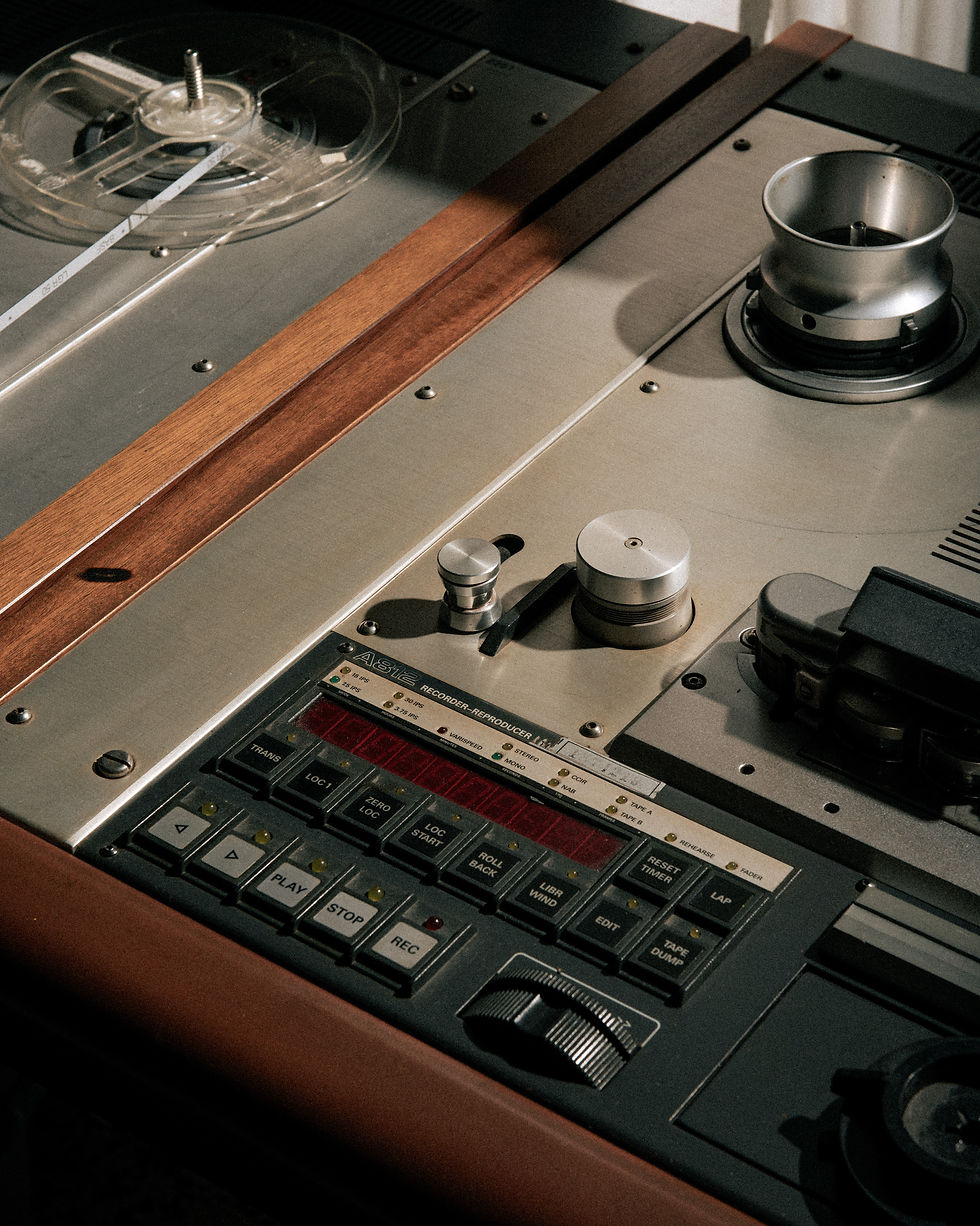
Stephane: It depends on the material you can locate and identify: multi-tracks tapes, 1⁄4 inch tapes. When you can get the original album’s edited tape, it's great. But it's more exciting to access the studio tapes, with all the takes in no particular order. Theres a very specific emotion when you put a tape that hasn't been played for 50 years on a Studer tape recorder. For example, we have been able to find the studio tapes on two great electronic scores by François de Roubaix, a cult one (La Scoumoune), a lesser known one (Les Anges). It gives you goosebumps to hear François' voice between takes, to hear him fiddle with his instruments, to hear him make a false start. Like fragments of the past in the present tense... Thanks to his home studio, his 8-track tape recorder,his two synths: EMS VCS3 + ARP Odyssey, and his extraordinary versatility as an instrumentalist, François could write and perform his own compositions at home, directly, recording himself playing different instruments on separate tracks. Pushing overdubbing techniques to the limit, he became the supreme author of his scores, with complete mastery of every stage in the creative process: composing, orchestrating, performing, recording and mixing. Having La Scoumoune and Les Anges released in their entirety 50 years later is a challenge to the passing of time. Seeing new generations listen to them as contemporary works is the greatest reward.


Synth History: What is one of your favorite pieces that you’ve added to the library so far?
Andrea: One of the most meaningful additions for me is Piero Piccioni’s Il caso Mattei (The Mattei Affair).
It’s a score that defies time, composed for a 1972 movie but still feeling astonishingly contemporary. What captivates me is the way Piccioni blends sophistication and experimentation: the elegance of his harmonic language colliding with a hypnotic, almost proto-electronic pulse. The music seems to coexist on two levels: the political tension of the film and a deeper, more abstract sense of restlessness that Piccioni expresses through repetition, texture, and rhythm.
When we brought it back into the catalog, I felt as if we were revealing not just a soundtrack, but a blueprint: something that anticipated later developments in ambient, electronic, and minimalist music. Its atmosphere is electric yet introspective; it creates a sense of investigative drift, a psychological landscape more than a narrative one. Working on it meant treating it with the same respect you’d give to a contemporary experimental record. It’s one of those scores that reminds you why preserving and re- presenting this heritage matters: it proves that the past isn’t behind us – sometimes it’s ahead.
Stephane: There are so many... I regret not having been able to meet Vangelis in time to ask him questions about La Fête Sauvage, how his score makes the animals speak or reveal their inner feelings.
With Andrea and the CAM Sugar crew, we're so proud of The Sicilian Clan's demos: it's the birth certificate of a score that will become iconic. Regarding Philippe Sarde (the most represented composer in the Sugarmusic France catalog), I recently found many psychedelic cues that deserve a proper release. And a Holy Grail: the English version of La Chanson d'Hélène, sung by Romy Schneider and spoken by Michel Piccoli. Why was it recorded but never released? Philippe doesn't remember. Listening to it brought tears to his eyes: he was then a 21 year old composer who, with astonishing maturity, tells the story of a couple who separate. It's a new treasure which will be soon available. To paraphrase poet Victor Hugo "The future is a door, the past is the key."
Read more about CAM Sugar here.
Synth History Exclusive.
Photos courtesy of CAM Sugar, credit Mattia Micheli.
Interview Conducted by Danz.


