
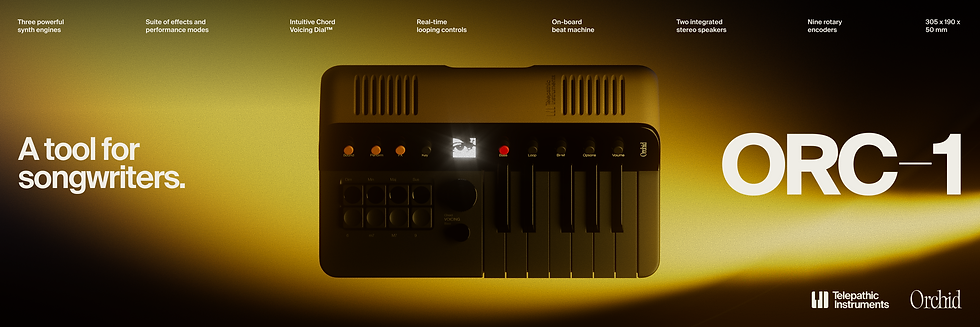

Interview With Tom Cosm, Telepathic Instruments
Next up in our extended interview series is synth designer, educator and musician, Tom Cosm of Telepathic Instruments, a company founded by Kevin Parker/Tame Impala, Ignacio Germade, Chris Adams, Charl Laubscher, Sophie Lawrence Parker and Tom himself!
Tom was kind enough to set aside some time to talk with me about what went into designing Orchid ORC—1. I was lucky enough to play with one of my very own and was keen to ask him some questions.
Photos by Stephanie Gainsford.
Without further ado…


Synth History: Can you tell me about your background in designing synths and what got you started in that direction?
Tom Cosm: I really got into designing sound synthesis first. I was studying jazz at university and when I got my first laptop, I got [Jeskola] Buzz, one of the tracker softwares. I think I played on some of the tracker softwares on an Amiga first, but I just completely fell in love with programming things digitally on a computer. I love patterns, numbers and music theory. It wasn’t the start of my musical journey, but it's the start of where sound synthesis came in.
I was born in Christchurch, NZ, which was a pretty small town. There wasn't really much as far as live performance. There were producers, but everyone was sort of keeping to themselves. I kind of taught myself how to use this tracker software by chatting with other people, and it was great. There were communities on IRC–old school internet relay chat–where I could chat with people [about sound synthesis].
If you fast forward a little, the real introduction into synthesis design for me, on a more heavy level, would have been when I started getting into Max for Live. I was always a producer throughout my 20s, using pre-existing synths, mostly digital. When I started getting into more teaching, educating and making content, I took the leap into Max for Live. I started programming mostly utility based production tools at first, and then I realized the whole sort of MSP digital synth design angle. I got completely hooked on that. That's where it all started.


Synth History: What was the process like for designing the Orchid for Telepathic Instruments?
Tom Cosm: The initial idea was always around the logic, the real human feel we could make with the chords. We always knew we wanted a proprietary synth engine, which we designed how we wanted it to be: comprehensive and a little bit different, but still with Kevin’s sound in there.
There was a lot of back and forth, swapping around ideas of how we’d see it. You know, “Do we want to have FM? Do we want to have this or that?” It was originally just a kind of virtual analog style synthesis. We knew we wanted four oscillators. So I started prototyping. I did a few prototypes in Max MSP first–which was great because there are so many ways that you can get from A to B quickly. There's oscillators, there's filters, there's ADSRs, there's all kinds of stuff. You can link them all up and prototype how you'd like your synth to be.
But I think ultimately, a lot of the character came from the fact that the first prototype's main synth engine had to run on a Raspberry Pi. Because of that, I wasn't able to use Max MSP or anything like that. I moved everything to Pure Data, a more raw form of Max MSP, but similar in that you can make objects and link them together. A lot of the stuff that I was using to help me kind of rapidly build this thing [in Max] weren’t in [Pure Data]–I had to build a lot of things from scratch. I had to make little mathematical groups that would do the right type of curves. And that was really fun, for me, because I hadn't worked much in Pure Data–like, "What? They don't have that? Okay, I'm going to have to figure out how to build this from its raw components." I think that kind of contributed a lot towards the sound.
From there, we sort of had the direction of where we wanted it to go. It was kind of a matter of starting with the virtual analog synth, just a couple of oscillators, a couple of envelopes and a filter basically. Next, let's add two more oscillators. And then… is four too much? Is four too little? No, four's good! Let's add an LFO, or let's make it a little matrix, let's add a couple of envelopes.
It expanded outwards and it was really great to send it back and forth between myself and Kevin. We built it as we decided what needed to stay and what needed to go. Then we thought, “Well, let's turn that into something!”
And yeah, it all kind of stemmed up from there. We just kept building it until we got what we wanted out of [Orchid]. It's got its own character. It's got its own depth. It can run the hardware, which is an important factor as well. That was the process of building it.


Synth History: In terms of the visual design, it has a very cool retro-futuristic kind of element to it, and I appreciate that it's portable and light. What inspired the visual design choices of the synth?
Tom Cosm: The visual stuff was a combination of people, but our key designer came on board and took it from the original prototype here. [Shows Prototype]


Synth History: Oh wow. So cool!
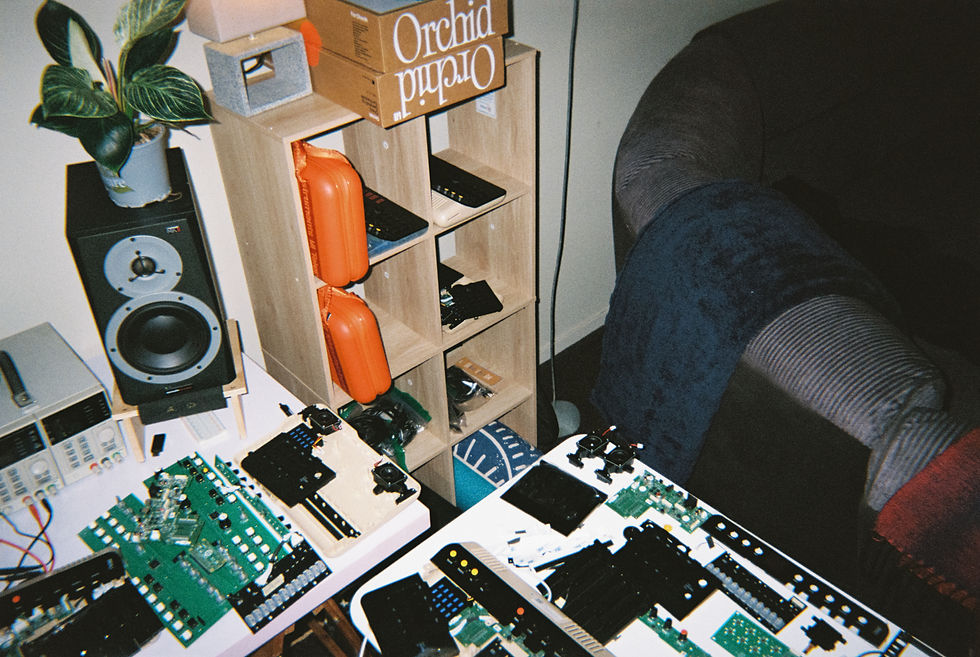
Tom Cosm: You can kind of see the Pi in there and the Arduino and some really terrible soldering and all that kind of stuff. I think we've got the very first sketch that Kevin sent to me on a piece of paper somewhere…
We had to go from [the prototype] to something. I only ever thought I was going to make one of these! That was the original sort of agreement, it was meant to be a personal thing for Kevin. It was during lockdown and I never really built the prototype thinking that it was going to be seen by anyone else. And then when we realized that it had quite a lot of potential and could be helpful for other people, we started building a team.
I started building a technical team and Kevin and Charl from Love + Money Agency, and Ignacio came on board who worked with Charl, who is an industrial designer and designed some amazing stuff in the past. He's done work for Polaroid and just has this amazing brain. It was actually quite eye opening for me, because I'd never gone through the process of someone who was so good at design coming on board.
There were story boards. We’d sit down and look at pictures of sunsets and cars and sci-fi control panels. We'd have these long meetings and just vibe on cool aesthetics and cool pictures and cool color palettes. Which again, was a real treat for me, because I'm usually focused on the inside of things: all the wires and stuff like that. I'd say Kevin, Charl, and Ignacio were the three people who had more of a keen eye for aesthetics for [Orchid].
There were quite a few different kinds of models made. The original models were made out of cardboard! There was a kind of carved wood one, and then a 3D-printed one, which didn't work at all. It went through all these different iterations and eventually we got down to what the Orchid is today. We all sort of instantly just went, “That's the one!” And it hasn't changed since.

Synth HIstory: The design is very chic and minimalistic, reminds me of a cool 1970s Italian organ or something!
Tom Cosm: I always love hearing what people relate it to personally. Whether it's nostalgic or something that they recognize from the past. And it's always slightly different, even if it's just a vibe or not a specific thing, you know.
Synth History: One feature that stood out to me as soon as I started playing it, was the chord and the bass voicing dials, which I thought were very intuitive and spark a lot of imagination. Can you tell me about the incorporation of those, because I don't know if I've ever seen those on a synth before?
Tom Cosm: No, I don't think I have as well. They were there from day one! I'd almost say that the voicing dial was probably the original spark of the idea. It was like, “Okay, we've got this one octave keyboard, and that's quite restrictive within itself. We've got these chord buttons. If we want to play these chords, how do we move up and down around the octaves in a way that just doesn't suddenly jump to the next octave?”
The whole point of [Orchid] is that when you're coming up with your chord–whether you know what you're doing or you don't–when you're coming up with these new fantastic chord progressions and happy accidents, it sounds as human as possible.
When you move the voicing dial it slowly moves the cluster of the octave keyboard. I think our Pistel software shows this, but if you visualize a keyboard and then gray everything out apart from 12 notes, as you move that dial up and down, it moves that box up and down the keyboard. That was the idea–you might sound like a jazz musician, moving up and down the keyboard. I guess you could say, to keep it simple, we didn't want any massive jumps when people were coming up with new chord progressions because they're quite jarring. Kevin sent me a description of how that would work from the very first day, and a few Max for Live objects with an idea of how he might see that going.



Synth History: What do you think are some of your personal favorite standout features that you hope musicians and producers will be able to take advantage of with the synth?
Tom Cosm: For me, it would be the little things. The voicing dial moves around quite carefully, which is probably my favorite feature, by the way. I went to a jazz school and as a keyboardist, I'm used to playing lots of chords with one hand and trying to not move around the keyboard as much as possible. How you move to the next notes and the different inversions really matters, it can change the mood on a micro level. A lot of these changes matter, so I would say that to me [the voicing dial] is a pretty key feature.
And I'd have to say the synth engine as well. I'm really proud of how that turned out. You know, for a digital synth to be able to have the full capabilities of an FM synth and a VA synth with four oscillators, but also have analog modeled electric piano sounds. We didn't really want to go super lo-fi with it, but we did want it to have the sound of an old electric piano that just has a softness to it. I think we did that really well. When you play it, most of the sounds sound like they would come out of how the thing looks, in my opinion. So, I really like that.
Synth History: I feel like sometimes with synths I’ll skip some presets here and there. But with this one I didn’t skip any! It feels very curated.
Tom Cosm: I can 100% back you up on that by saying that they're all designed by Kevin. He sat down and worked extremely hard on each one of those to be exactly what he wants it to be–as a solo sort of note, and also as different chord progressions. There's a white noise-y and windy sound effect. They're all made to be beautiful harmonic layers rather than individual notes–not saying they don't work as individual notes, but that's always a thought that goes into almost everything.
Synth History: It was fun playing around with the bass. Sometimes I’ll send synths out through an amp and rerecord them [for warmth], but the Orchid sounded good already. Just very pleasantly surprised. I played with it a little bit at NAMM and was happy to play with it more. It's also its own sort of workstation. You can take it with you on a plane, wherever, and play with ideas and loop.
Tom Cosm It's become a lot more comprehensive than we originally thought. It's an ideas machine. It's all good keeping [ideas] in your head or writing them down on a piece of paper, but we wanted people to be able to actually capture an idea and loop it over and evolve it or change it–change the sound once they've recorded it. So the looper was sort of the last thing. We added more performance modes, more sound effects. We added various different options for when we started seeing different people play it apart from me and Kevin. We were like, “Okay, well this person prefers to hold a chord down and sort of queue up the next chord, when they play the next chord it'll play the chord they queued up. And some people want when they push the chord button to change immediately regardless of what they're doing with their other hand.” So we’ve added lots of little quirks that can make it act like how you want it to act as well. It's come a long way.
Synth History: So this is my last question and you don't have to answer it unless you want to! I wanted to ask if there was anything else in the works for Telepathic Instruments? Will there be another synth on the horizon or another piece of equipment, or more updates for Orchid?
Tom Cosm: Yes. We have a very specific short list of ideas, whether it's software or hardware. You will be seeing more physical objects from us. We will be continuing to put as much work as we have into evolving the Orchid firmware. There's a lot more features we want to add, more sounds, more ways of playing it and things like that.
I will say that we've really had to expand our team a bit because of how much work there is. That was sort of the first part. And now we’ve sort of got to a place where we're like, “Okay, now we can actually work on building new products without everybody going insane from working too hard!” So yeah, I'll leave it at that for now. We're not going anywhere and we're having a lot of fun. We've got some really cool stuff coming up.
Synth History Exclusive.
Interview conducted by Danz.
Photos by Stephanie Gainsford.


