

Interview With Daniel Pemberton
Got to chat with the amazing composer and songwriter Daniel Pemberton who recently scored Project Hail Mary, directed by Phil Lord and Christopher Miller and written by Drew Goddard, based on the 2021 novel by Andy Weir. Pemberton's resume is impressive to say the least! From Spider-Man: Into the Spider-Verse to his recent score for The Drama, to even scoring games like the LittleBigPlanet series (which I highly recommend playing).
We talk about composing the score for Project Hail Mary, his process, the early days of his career and more down below.
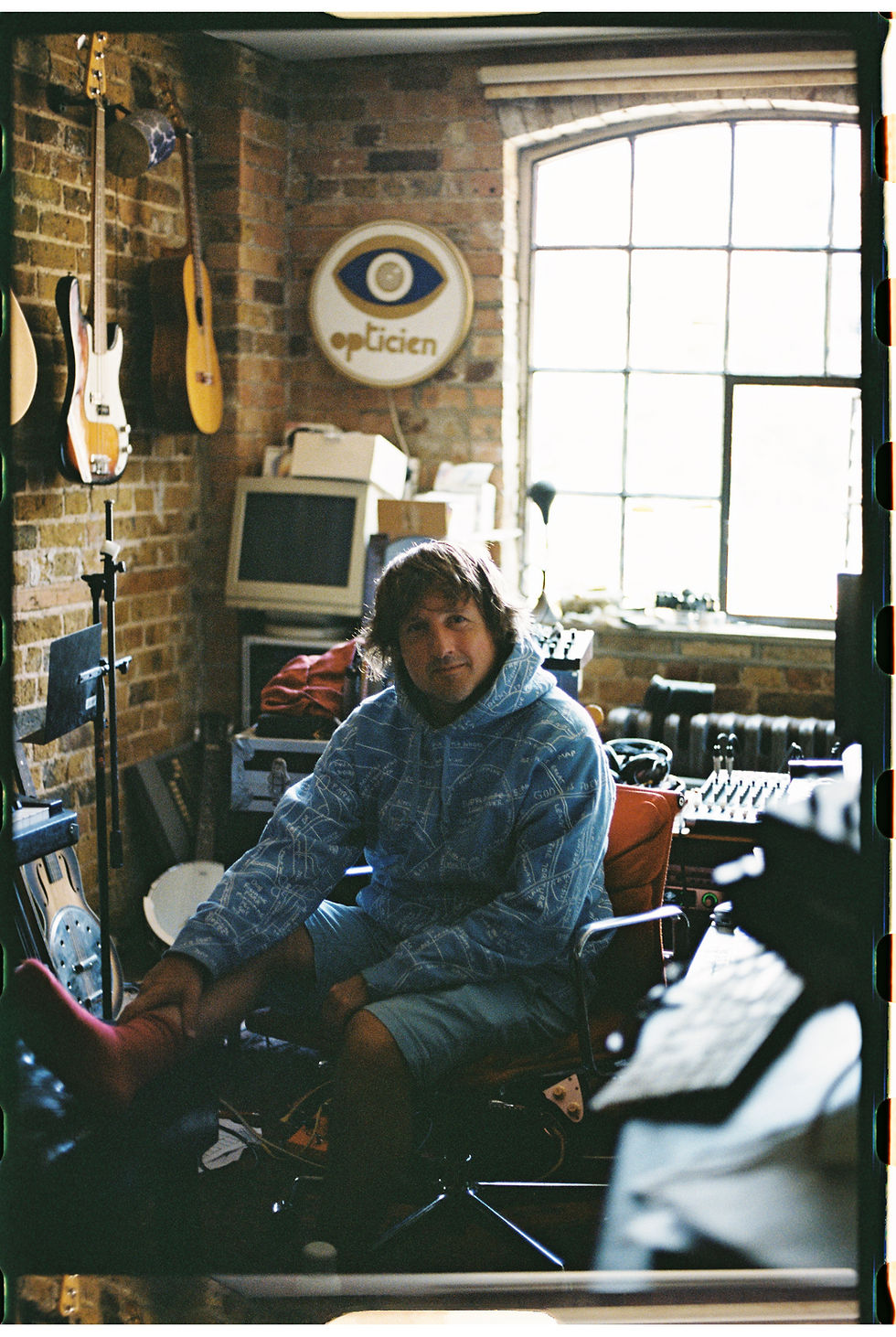
Photos by Tommy Cissell.
Without further ado...
Synth History: I read that you started composing for films when you were 17 years old!
Daniel Pemberton: Yeah, I did my first documentary. I was making strange electronic music as a teenager and I made a record when I was 16 called Bedroom which a director, Paul Wilmshurst, heard and he liked it and asked me to score a documentary he was doing. So I did my first sort of score when I was 17.
Synth History: Was scoring films something that you always planned to do—what was that transition like?
Daniel Pemberton: I think, I didn't really know what I was doing and I still sometimes feel like I don't know what I'm doing! I actually make that part of my approach to each film. You know, if you look at Project Hail Mary, a big part of the challenge with that score was trying to create a new sound. And when you create a new sound, you don't really know what you're doing. If you're doing something that you've done a million times before, you're very well-versed in it. But that kind of sense of exploration and experimentation is something I always try and keep as often as I can on most of my films. I try and make each thing feel quite different.
Synth History: In terms of creating the score for each film, do you have any go-to pieces of equipment or gear, or is it always changing based on the project?
Daniel Pemberton: Well, it kind of changes. I'm weirdly not a massive gearhead. I started off with just one piece of gear, a Korg Wavestation and a Fostex X28 four-track. That was all I had. I didn't even have a sequencer! I only had one keyboard. But I knew how to program it so well to a level that I don't think I've ever got to again. I knew the entire in and out of that machine. But the trouble is, the more gear you get, the more you tend to stay at a surface level with it.
What I do is try and build as much of my own kind of gear, so to speak, as possible in terms of sounds. I'll do a lot of sample set building on every project, that will either go through experimentation and jams where we try and make loops or sounds, or it will be very conscious sound creation to make instruments. On Hail Mary, I made a whole load of sounds out of a lot of unusual percussion, out of vocals—I've got a great assistant, Alex, and he helps build Kontakt engines, which he's a lot better at than me now. We'll build a whole bunch of quite interesting sounds and textures that hopefully I can play in an expressive way rather than just adding effects on top. Then, I'll merge that with real recordings as well. And that's what kind of gives it a sort of unusual feel sometimes—there's things that are real, things that are sampled and treated, and they're all kind of mashed up together.


Synth History: When you start working on a film, do you start in a studio like Abbey Road for example, or do start from home?
Daniel Pemberton: I start writing at home. I have a very crappy setup which is basically just a Mac and that's kind of it. I try and bring as much out of the box into the box through these different processes, but then I also leave a lot of space to experiment when I go and record (in a studio). So, I'll write for ages at home and get it as far as I can. And then eventually we normally go and record at Abbey Road or AIR, and then it becomes a much bigger production, trying to work on the strengths of the musicians, experimenting in the room. Sometimes I try and play the orchestra or the band a bit like a synthesizer and try and throw heavy experimentation out there very quickly, which can be very exciting.
You know, if you're on a synth, you might think, "Right, let's assign a filter to LFO and let's do the LFO at 16 and let's make it a hard square tooth". If you can explain that to an orchestra that might be playing something that's not as exciting, suddenly you can get something very interesting and very unexpected.
Synth History: It must be so cool to go from working on it at home and then hearing it when you're in there with an orchestra with all those people playing!
Daniel Pemberton: Yeah, that's always really exciting. It's always slightly terrifying as well because there is so much to do and you're always running out of time, running out of money, but it is really cool when you hear it.
Synth History: So for the score for Hail Mary, how long was the process?
Daniel Pemberton: I was on it for a very long time. I was on it for about two years. I started off with very early experimentation, just sort of research and development. One of the first things I came up with, weirdly, was I sampled a friend's pipes. He had these very squeaky pipes in his house that had a very cool sound that I ended up recording on my iPhone, which ended up turning into a sample set! That was very effective in creating these very unusual textures. I was writing stuff that was being played to Ryan [Gosling] on set early on, and then as the film progressed, I got more involved and by the end I was pretty much in lockstep with the edit.


Synth History: The squeaky pipes—is there a particular part of the movie that you can point out where they're used?
Daniel Pemberton: It's all over the movie. It doesn't sound like a squeaky pipe; it sounds like a sine wave! And so I wrote using that sound a lot and then I was trying to work out how we could recreate it with live instruments. We ended up using this thing called a Cristal Baschet, which I then doubled the samples with. So you get a kind of unusual sound where you can't tell what it is. That's something I'm very into doing, which is blending sounds, both organic and electronic, to create something more unexpected.
Synth History: With the film—I guess at this part of the interview I can put a little spoiler alert section [laughs] but do you have any favorite parts of the film that your score is in? Spoiler Alert
Daniel Pemberton: Yeah, it's kind of interesting because actually my favorite bits turn out to be most other people's favorite bits as well. I think the bit where [Ryan] sort of turns the camera on for the Astrophage, the cue is called "Moment." That is one of my favorite cues. And when they go fishing is another one. When he says goodbye to Rocky, I love that cue as well.
Synth History: I love Rocky so much. It was such a fun surprise because I didn't know—I mean, I had seen the trailer obviously, but I wasn't quite sure what to expect and I was so happy with where the movie went. As a vintage synth nerd, I really loved in the beginning of the movie where the vintage synths are in the classroom!

Daniel Pemberton: Oh, yeah! I've got some vintage synths as well, like I've got a CS-80.
Synth History: Oh, whoa, nice. The Vangelis synth!
Daniel Pemberton: Yes, I've got that. I've got a Korg Mono/Poly, the Roland SH-1000 which I really like; it's a really old monophonic synth and it's got a really lovely, kind of organic quality, that feels like quite a special synth to me. I'm just looking around my flat now... I really like the VSS-30, which is a kind of really cheap Yamaha sampler. I've used that a lot on Slow Horses. And then there's a bunch of other things as well, but those are sort of the ones that are within grabbing distance of me right now.
Synth History: I wanted to ask you in terms of your personal influences, what is some of the music that you grew up listening to or your favorite artists or composers that inspire you?
Daniel Pemberton: Growing up I was very into synths. Synth music actually was my kind of beginning. My dad took me to the Planetarium in London. I wasn't really that interested in music, but then I went there and saw a laser show and the music just blew my mind and from then on I was obsessed. From that, he got me a Jean-Michel Jarre album and a Mike Oldfield one and I taped those and just listened to them relentlessly. Through that I got into Vangelis, Neu!, Tangerine Dream, Yellow Magic Orchestra. And then in the 90s, a lot of interesting ambient music was starting to come out of the UK, and I got obsessed with that. It'd be things like Future Sound of London, a band called The Grid, Aphex Twin.
There was a really interesting ambient scene and I started going to some very unusual raves. One of which was this thing called Telepathic Fish, which were these parties held in squats in Brixton. They've just actually released an album of that stuff. That's where I started meeting people. I met this DJ called Mixmaster Morris, and he liked the music I was making on the Wavestation and tape machine. So I started handing out tapes and that's kind of how I got my first record.
So my background really is very electronic and very synth-driven and I think maybe as a film composer I've sort of stepped away from that because I feel like I've spent a long time in that world. I'm always trying to do something different, but I'm definitely going to have a moment where I come heavy back into the synth world.


Synth History: It's cool though how you blend acoustic instruments and the electronic instruments. Even in terms of terminologies, love your example of the square wave and kind of explaining that to an orchestra. It's a neat way of using synthesis and acoustic instruments together.
Daniel Pemberton: For me, everything really is just about sound and music. What I learned is everything has an equal value. We're conditioned to think an orchestra is more important because it's harder, it's more technical, and a lot more skill in certain levels is needed to play at a high level. But you can still get an amazing sound out of a 303 where you're just bumping some buttons on it. When you start doing film music, what's interesting is you just look at everything for the sound. You get people who will only play synths and have no interest in live instruments, but for me, I'm interested in everything. That's the best thing about being a film composer: you're not pigeonholed. You're not in a synth band so you have to use synths, or a classical composer so you can't use anything electronic—I can just use any noise there is and put them together. That's the thing that's most exciting for me, pulling all these different strengths of different sounds together. Those early days I had with that one synth taught me so much about sound programming and sound creation, and I've taken that mindset into a career where I've ended up having the good fortune to be able to work with amazing live players as well, but I've still got the mind of a bedroom composer, really.
Synth History: You've worked on such incredible movies and made such incredible scores; I think readers will be excited to read about your story!
Daniel Pemberton: I do think it's important that you don't need all the gear. Especially in film music in America, there's a real thing of, "Check out how much gear I've got; can't make film music until you have all this gear". I think the most interesting stuff is when you have the least and you learn how to use it and get something unusual out of it. I did a film score called Brian and Charles—it was a super low-budget British indie movie about a guy who builds a robot. I wanted to write a really kind of lo-fi synth score because I wanted to go back to these roots. And for that whole score, I pretty much did the entire thing on a Korg Mono/Poly and the SH-1000 and a couple of FX boxes and a Mini Pops drum machine. That was it. It was really exciting to work within these limitations and be like, "Well, what can I do with this?"
Synth History: Do you think you're able to get more creative when you have limitations?
Daniel Pemberton: Yeah. I think limitations are super important because you can do anything now. Back when I started off, I had to really think about what went on each of those four tracks on my four-track! Whereas now, I've got infinite tracks. It doesn't necessarily make better music. I mean, you can definitely make more exciting and richer music with it, but it doesn't necessarily mean it's better. The time you spend thinking about something is interesting, because as a film composer you're always heavily under a deadline. But I just did a movie called The Drama—for that I wrote the entire score just on three flutes!
Synth History: Oh wow that's cool!
Daniel Pemberton: And that was really interesting because there's certain things you can do with three flutes and other things you can't. I wanted to be really purist about it, and the director Kristoffer [Borgli] was also like, "Let's keep it this palette only". It was a really fun challenge because I had to work with just those three noises, basically three mono sounds, and it ends up being quite an effective score. Whereas on the other side of that, I've just done this film Masters of the Universe, and that is the most ridiculously maximalist score. It's got every single thing in the world on it—I've got a rock band, a choir, tons of synth, tons of guitars, tons of percussion, tons of drums. I've even got Brian May from Queen playing on it.
Synth History: No way!
Daniel Pemberton: I like being able to jump from writing minimalist flute music to making an epic rock opera that's completely over the top and has guitar solos everywhere. It's fun just jumping between all these different modes.
Synth History: I have two last questions. The first one: if you could recommend one album, or a soundtrack or score for someone to listen to at least once in their lifetime apart from your own, what would it be?
Daniel Pemberton: I think one of my favorite albums that I have slightly burnt out is Apollo by Brian Eno. There was a period when I was discovering his music and a lot of other people around that kind of scene like Harold Budd. That album for me is an amazingly beautiful album—very evocative, very transformative, and has a sort of weird cosmic magic in there that is rare to find. I have listened to it too many times.
Synth History: If you could give one piece of advice to aspiring musicians and composers, or something that you would tell your younger self, what would it be?
Daniel Pemberton: I think embrace your limitations and don't try and copy other people to get their sound. Try and just make your own sound out of what you've got. And if you've got hardly anything, then make the best out of that. It's difficult now because you can have access to so much software, but actually just find one thing and try and make as much on that as you can. Just like try and really get to the guts of a few things and you'll really learn to how to make something feel very original.
Synth History: Lastly, is there anything you want to tell people to look out for in terms of the score in Hail Mary?
Daniel Pemberton: I think it's just an interesting journey from going to these sort of underground raves in the 90s, Telepathic Fish, which really immersed me in the world of sound, and almost 30 years later doing Project Hail Mary, which in some ways is embracing that world I was in, this sort of rich tapestry of sound. It's been really lovely hearing how people have been reacting to that film and how they are having a huge emotional impact on them. I spend most of my time trying to work out how to make people cry, so I'm pleased I have!
Synth History: I was definitely tearing up. I think it's one of my favorite movies of the year so far. You did an amazing job and it's an honor to talk to you. Thank you for your time!
Daniel Pemberton: Thanks so much!
Synth History exclusive.
Interview conducted by Danz.
Photos by Tommy Cissell provided by Daniel Pemberton.
Project Hail Mary still provided by Amazon MGM.


